
May 28, 2026
Recently, eleven-x CEO Dan Mathers was featured in Parking & Mobility Magazine by IPMI discussing the growing importance of parking data quality and how organizations are using real-time insights to improve operations, policies, and the overall parking experience.
To read the full article, click here.
As parking systems become more connected and expectations around mobility continue to evolve, the conversation is no longer simply about collecting data. It’s about understanding what type of data is actually needed for specific operational goals, fit-for-purpose data, and which technologies are best suited to deliver it.
Different parking technologies offer different levels of granularity, cadence, and accuracy. While solutions such as LPR, cameras, payment data, vehicle counting, and zone-based monitoring can all provide valuable insights, certain use cases — like real-time parking guidance — often require more precise, stall-level visibility to deliver the best possible results.
Ultimately, better decisions start with understanding what level of data quality is required for the outcome an organization is trying to achieve.
Why Parking Data Quality Matters
Organizations today are under increasing pressure to optimize parking operations, manage curb space more effectively, improve driver experience, and support broader mobility goals. However, achieving those outcomes depends heavily on the quality of the data being used.
As Dan explains in the article, parking data varies across three key dimensions: granularity, cadence, and accuracy.
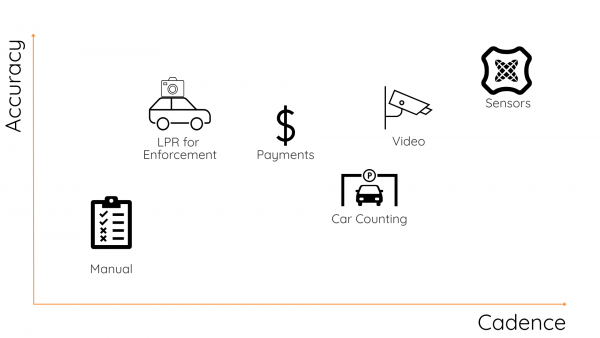
The way data is collected, whether through payment systems, vehicle counting, LPR, zone-based monitoring, or stall-level sensors directly impacts all three.
This distinction matters because different parking objectives require different levels of visibility.
Fit-for-Purpose Data Starts With the Goal
One of the most important takeaways from the article is the idea of “fit-for-purpose” data.
For example, a gated garage operator looking to understand overall peak demand may only require basic occupancy insights. But if a city wants to provide real-time parking guidance or support demand-based pricing, much more detailed and accurate data becomes necessary.
The key is starting with the asset and operational objective first, then identifying the level of data quality required to support it.
Why True Occupancy Changes Everything
At the highest level of parking intelligence is what the industry increasingly refers to as “true occupancy.”
True occupancy provides continuous, stall-level visibility into parking utilization across an environment. Unlike estimates or partial snapshots, it creates a consistent and trusted foundation for operational decision-making.
That level of visibility enables a wide range of advanced use cases, including:
More importantly, these capabilities translate into measurable operational outcomes: reduced congestion, improved driver experience, stronger revenue performance, and more informed policy decisions.
Closing the Gap Between Perception and Reality
One of the biggest challenges in parking management is the disconnect between perceived parking availability and actual utilization.
Without accurate occupancy data, organizations often rely on assumptions when making policy or operational decisions. Modern parking technologies are helping close that gap by providing scalable, verifiable, real-world visibility into how parking assets are actually being used.
When organizations understand true demand patterns, they can:
The Future of Parking Is Data-Driven
As AI and predictive analytics become increasingly important across the mobility industry, the importance of high-quality parking data will only continue to grow.
As Dan notes in the article, AI is only as effective as the data behind it. Organizations that invest in strong data foundations today will be better positioned to support smarter operations, more responsive policies, and better user experiences in the future.
Ultimately, parking data is no longer just about counting vehicles… It’s about enabling smarter decisions across entire transportation ecosystems.
That’s the shift from guesswork to ground truth.